Christmas is celebrated throughout Europe, but each country experiences it in its own way. Spain, with its blend of religious spirit, festivities, abundant cuisine, and family gatherings that extend well into January, offers a unique set of customs. In this article, we compare how Christmas is celebrated in Spain versus other European countries, highlighting what makes these dates so special in Spanish culture.
- Key Dates: A Longer Calendar Than in Much of Europe
In Spain, Christmas doesn’t end on December 25th. In fact, the Christmas season officially extends until January 6th, Three Kings’ Day (Epiphany).
In many other European countries—such as Germany, France, and the United Kingdom—the end date is usually December 26th (Boxing Day).
Key Dates in Spain:
December 22nd: The Christmas Lottery draw, a national event.
December 24th: Christmas Eve, a night for family and religious observance.
December 25th: Christmas Day, a quiet celebration.
December 31: New Year’s Eve and the traditional twelve grapes at midnight.
January 5–6: Three Kings’ Day parade and gift-giving.
In other European countries, gifts usually arrive on December 24 or 25, making the Spanish wait until January a notable anomaly.
2.Christmas Gastronomy: A Varied and Regional Feast
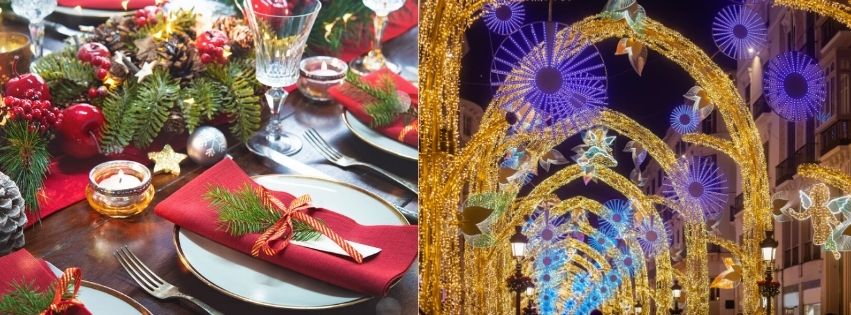
Food is one of the cornerstones of Christmas in Spain, and each region has its own special touch.
Typical Spanish Dishes and Traditions:
Seafood and roast meats (lamb, suckling pig) on Christmas Eve.
Turrón, polvorones, and marzipan, classic sweets of Mediterranean origin.
Roscón de Reyes (Three Kings’ Cake) with cream or custard, eaten on January 6th.
Catalan Cava for toasting.
Comparison with other European countries:
Germany and Austria: sausages, roast goose, and sweets like Stollen are prevalent.
United Kingdom: Christmas pudding, mince pies, and stuffed turkey.
Italy: Panettone, pandoro, and lighter dinners.
Nordic countries: marinated herring, roast pork, and drinks like glögg.
Spain stands out for its regional variety and for menus that tend to be more festive and abundant.
3. Gift-giving: The Three Wise Men as protagonists
Although Santa Claus has gained popularity in recent years, in Spain the true protagonists are the Three Wise Men, who bring gifts on the night of January 5th to 6th.
In contrast:
Central and Northern Europe: Santa Claus (or Saint Nicholas) delivers gifts on December 24th or 25th.
Countries like the Netherlands and Belgium: Sinterklaas distributes gifts on December 6th, well before Christmas.
The Three Kings Parade, with its floats, music, and sweets, is a celebration practically unique in the world.
4. New Year’s Eve and the ritual of the 12 grapes
If there is one internationally recognized Spanish tradition, it is eating 12 grapes to the rhythm of the chimes of the clock. Each grape symbolizes good luck for a month of the new year.
Other countries celebrate New Year’s Eve with fireworks, toasts, or local rituals, but Spanish grapes are a unique tradition that has no direct equivalent in the rest of Europe.

5.Christmas Carols, Nativity Scenes, and Religious Celebrations
In Spain, the nativity scene occupies a central place in homes, churches, and public squares.
Distinctive Aspects:
The creation of highly detailed nativity scenes, sometimes even featuring living figures.
Traditional Christmas carols accompanied by tambourines and zambombas (friction drums).
Midnight Mass on Christmas Eve.
In other European countries, the following predominate:
Christmas trees (although also popular in Spain).
Christmas choirs and markets, as in Germany and Austria.
Lesser prominence of the nativity scene in public life.
6. Christmas Markets: More Understated Than in Central Europe
Although Spain has iconic Christmas markets (such as those in Madrid, Barcelona, and Seville), their style tends to be simpler compared to the famous Central European markets.
In countries like Germany, Austria, and the Czech Republic, Christmas markets are genuine tourist attractions, with elaborate decorations, mulled wine (Glühwein), and handcrafted goods.
Spain, on the other hand, maintains a more traditional and family-oriented approach.
A warm, long, and deeply family-oriented Christmas. Christmas in Spain combines religious observance, gastronomy, popular festivals, and family gatherings that extend for almost three weeks.
Compared to other European countries, it stands out for:
A longer duration thanks to the Three Kings.
Unique traditions such as the 12 grapes (eating at midnight) and the Three Kings Parade.
A strong regional character in food and celebrations.
A milder climate, which allows for outdoor activities even in the middle of December.
All of this makes Spanish Christmas a heartwarming, diverse, and unique celebration within the European landscape.